How GasNet built a universal, AI-ready serverless IoT platform on AWS with Trustsoft

GasNet distributes gas to 2.3 million customers across roughly 80% of the Czech Republic through 69,000 km of pipelines and 3,000 pressure-regulating stations.

When GasNet began developing its IoT strategy, it already had around 22,500 telemetry endpoints across several independent solutions, with the potential to grow to up to 2.3 million endpoints across more than 2 million delivery points.
The challenge was not simply connecting more devices. GasNet needed a platform that could turn messages from different devices and technologies into reliable, meaningful enterprise data.
Together with Trustsoft, GasNet built a universal, serverless IoT platform on AWS designed to do exactly that.
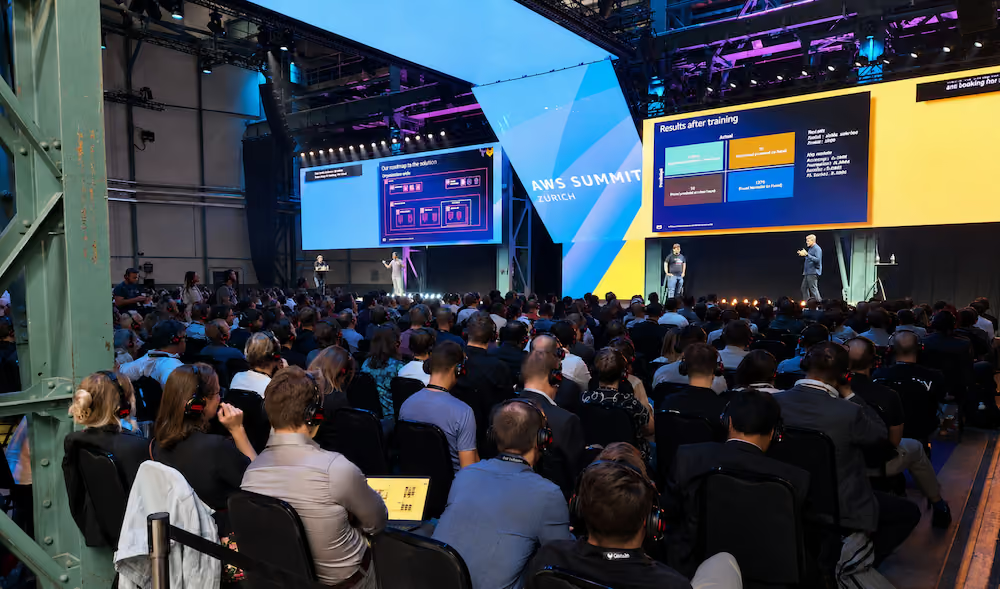
This article is based on breakout session PRT206-S at AWS Summit Zurich on September 2, 2026, presented by Zdeněk Bulan (Trustsoft) and David Ženčák (GasNet). See the session in the Summit agenda.
Built for devices that can last 20 years
Utility field devices can remain in operation for 15 to 20 years. During that time, connectivity standards, security requirements and business systems can all change. The original device supplier or partner may even disappear.
GasNet's fleet reflects this reality. Around 18,000 devices cannot receive remote firmware updates. The network uses GSM, GPRS, LTE and NB-IoT, and many devices do not have unique certificates.
Instead of forcing every device onto the same technology, the architecture isolates device-specific limitations from the rest of the platform. This allows the platform to evolve without replacing or modifying devices already in the field.
Turning measurements into meaningful data
A measurement is only useful when you know what it describes.
The architecture separates the physical asset, IoT device, measurement definition and measured value. The Enterprise Asset Management (EAM) system remains responsible for assets and their lifecycle, while the IoT platform manages devices and the metadata needed to interpret their messages.
For example, a device may send a simple hexadecimal string. The metadata store connects that value to the right device, sensor, asset, location, variable and unit. Only then does it become meaningful, such as methane concentration in parts per million at a specific location.
The platform also supports complex relationships, such as one device collecting data from several sensors or one meter being read through multiple devices.
Delayed data is interpreted using the configuration that was valid when the measurement was taken, making the data easier to trust and audit.
“The biggest challenge was building a platform that could continue working even as the devices, technologies, and systems around it change. We wanted to ensure that a device installed today can still be supported 15 or 20 years from now without having to redesign the entire platform.”
David Ženčák, Business Consultant, GasNet
Designed to evolve
The processing pipeline has five stages:
- Connect handles device communication and protocols such as TCP and UDP.
- Translate converts device-specific payloads into standard values.
- Understand adds the metadata needed to give each value meaning.
- Decide applies business and data quality rules.
- Publish sends trusted data to downstream platforms and dashboards.
The data itself is organized into three layers:
- RAW keeps the original message.
- MESSAGES contains parsed, validated and enriched data.
- MEASUREMENTS contains the enterprise metrics used by other systems.
This means adding a new device should only require changes at the edge, such as a new parser or measurement type. The data model, stream architecture, rules and downstream integrations can remain unchanged.
The AWS architecture
Devices reach AWS over NB-IoT and Direct Connect through a lightweight UDP gateway built with Network Load Balancer, Amazon ECS and AWS Fargate.
Amazon MSK provides the processing streams, while AWS Lambda moves data between layers. Amazon DynamoDB stores metadata and rule state. Amazon Data Firehose writes data to Amazon S3 as Apache Iceberg tables, while Amazon Timestream for InfluxDB and Amazon Managed Grafana support real-time data and visualization.
“AWS was originally adopted with IoT Core in mind, but many of GasNet's existing devices are not native IoT devices and communicate over plain UDP. The gateway lets us support these legacy devices while keeping IoT Core available for future devices.”
Zdeněk Bulan, Senior Cloud Architect, Trustsoft
Built to scale and ready for AI
The platform currently peaks at around 2,000 messages per hour, roughly 50,000 per day. It has been performance-verified at around 420,000 messages per hour and performance-tested at around 4.2 million per hour.
More importantly, the platform creates a reliable foundation for future AI use cases. Raw messages are retained, while validation, quality rules and contextual metadata create trusted and auditable data.
This opens the door to use cases such as:
- Anomaly and leak detection
- Predictive maintenance
- Automated data quality checks
- An operations copilot combining live telemetry with EAM history
AI readiness starts with reliable, well-structured and contextualized data. The architecture provides this by default.
Three lessons from the project
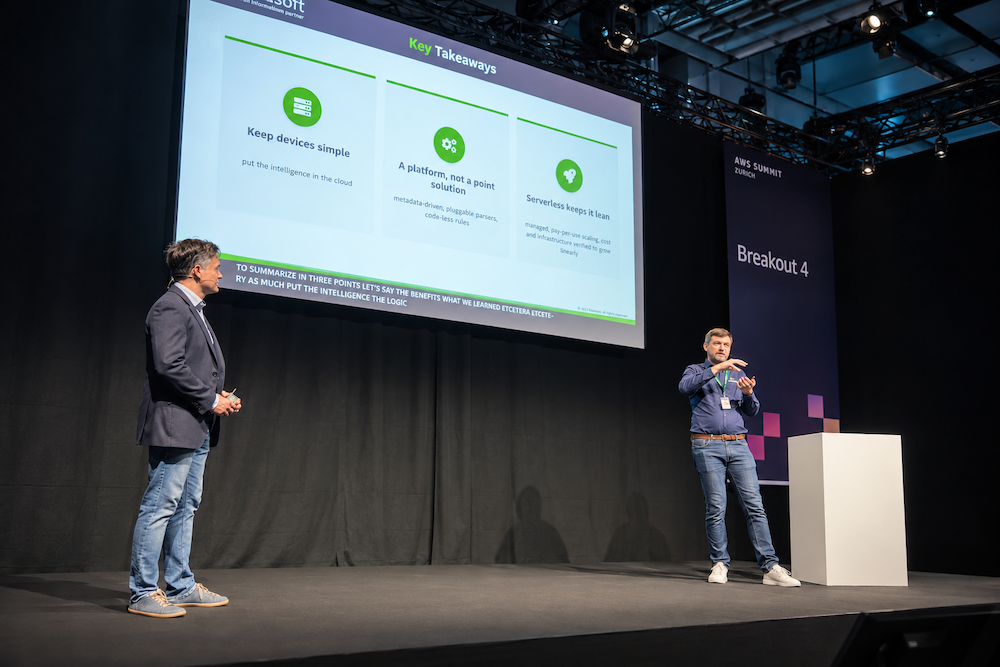
Keep devices simple and put the intelligence in the cloud. Device-specific logic stays at the edge, making it easier to modernize the platform without replacing the device fleet.
Build a platform, not a point solution. Metadata-driven processing, pluggable parsers and configurable rules make it easier to add new devices and use cases.
Use serverless services to keep it lean. Managed, pay-per-use AWS services make it easier to scale while keeping infrastructure requirements and costs measurable.
Building an IoT platform that can outlive its devices
GasNet's platform is built around a simple principle: devices will change, but the platform should not need to change every time they do.
By separating devices, measurements, business rules and enterprise data, GasNet can support a diverse device fleet while building a reliable foundation for analytics and AI.
Trustsoft is an AWS Premier Tier Services Partner and AWS Managed Service Provider. We have also worked with GasNet on modernising and securing its AWS environment.
If you are designing a platform that needs to outlive the devices connected to it, our data, analytics and machine learning team can help.